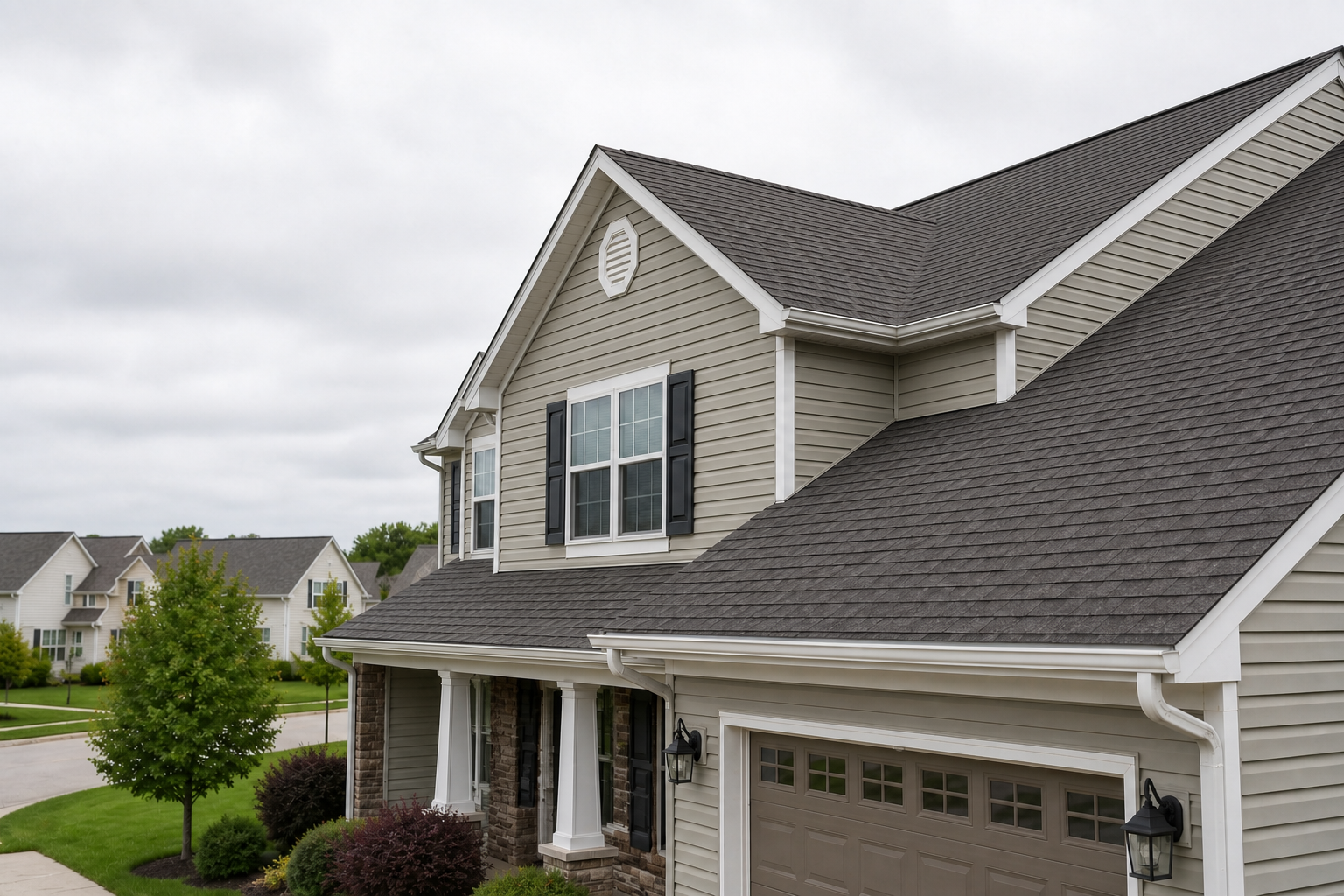
Fargo's older streets and mature tree canopy
The blocks around North Dakota State University and the older residential streets nearby carry some of the tallest trees in the city, and that canopy does two contradictory things in a wind event. It breaks up straight line wind before it hits the roof directly, but it also means more limbs coming down on gutters and more branch punctures in shingles.
After a hard wind event in these older neighborhoods, our first calls are usually about a gutter section torn loose by a falling limb rather than wind lifting shingles on its own, which changes what we bring on the truck for that first stop.
West Fargo's split between sheltered streets and open new ground
West Fargo genuinely splits into two different storm profiles depending on which part of town we are called to. The established streets near Sheyenne Street sit closer together with more mature landscaping breaking up the wind, while the newest subdivisions pushing toward open farmland get hit with wind speeds closer to what an unsheltered rural lot experiences.
That split shows up in the repair calls. Older West Fargo streets tend to bring us branch damage and clogged gutters, while the newer edge of town brings us lifted shingles and gutter hangers that failed outright under a gust with nothing around to slow it down first.
Moorhead and the river corridor after heavy rain
Moorhead takes the identical wind and hail that Fargo does, since the Red River running between the two cities does nothing to slow a storm system down, but the calls out of Moorhead after a heavy rain event lean harder toward grading and downspout placement. A number of Moorhead properties sit close enough to the river that where the downspout dumps water actually matters during a wet stretch.
Horace and Casselton on open ground along the interstate
Horace sits along the interstate south of Fargo on ground that used to be open farmland, and a lot of its newer subdivisions still have little in the way of mature trees to slow wind down. Casselton, farther out along the interstate, has even less shelter, sitting on genuinely open prairie with older farmhouse construction.
Storm calls from both towns skew toward direct wind damage, shingles lifted or torn rather than punctured by a falling branch, and siding that has taken a beating from wind driven rain with nothing around the house to break the gust first.
Kindred and the smaller towns along the highway
Kindred sits farther south along the highway past Horace, a smaller community built around older farmstead construction with a housing stock that in a lot of cases predates the newer subdivisions closer to Fargo. Storm calls out here are less frequent simply because there are fewer roofs to call about, but the ones that come in tend to be more severe, since an older roof handles a hard wind and hail event worse than a newer install closer to town.
We do not treat a Kindred call as out of range just because the drive is longer. It usually means the storm hit a house with less margin left in the roof to begin with.
How this shapes what we do after a big storm
When a storm rolls through the whole area in one pass, we cannot get to every call at once, so we triage based on what each town's damage pattern usually looks like rather than working strictly in the order calls came in. An active leak in an older Fargo neighborhood with a branch through the roof gets a same day response ahead of a cosmetic hail check on a newer West Fargo roof that is not letting water in yet.
That pattern holds across Horace, Casselton, and Kindred too. Wind damage that has already opened the roof to the weather moves to the front of the line, and inspection only calls for insurance documentation get scheduled in behind the active leaks.